Coverage
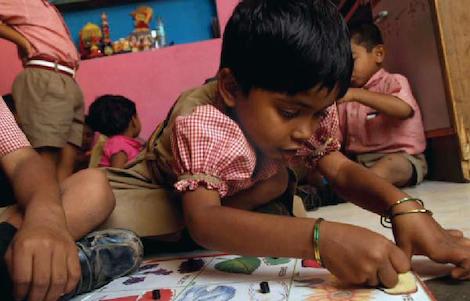
This refers to:
Number of centres across the geography
Number of children across the geography
For example, in Bangalore, pre-school centres are being run by:
The state-run ICDS which runs centres called anganwadis. There are 1552 anganwadis. Anganwadis are also responsible for health and nutrition but our initiative is limited to education.
Independent balwadis initiated by Akshara Foundation. In December 2009. there were about 110 centres. This is a self- sustaining model and is provided with training, TLM and financial assistance for the first six months; beyond that period, assistance in the form of follow up training is provided.
Teaching Learning Material
To develop high quality content and curriculum and prepare best in class Teaching Learning Material (TLM). The content, curriculum and TLM will be peer reviewed to ensure that this is of the highest quality. Metrics are mainly qualitative and based on:
Documented feedback from peers and subject matter experts (SMEs) Feedback from teachers who manage anganwadis and independent balwadis Reactions from children
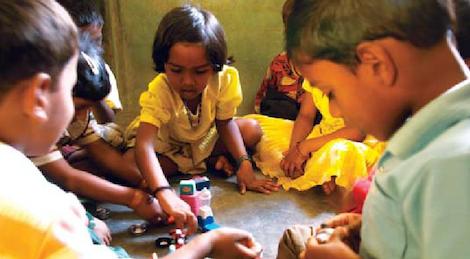
The TLM for the programme was developed using the help of preschool Subject Matter Experts (SME’s). The TLM was finalized in consultation with the Government. The kits include the following material:
Play material
Rope
Big ball
Peg Board
Seriation rings
Construction squares
Lacing Board
Number Blocks
Vegetable/Fruit basket
Colours and Shapes Kit
Charts
Alphabet Charts (Kannada and English).
Number Charts.
Language/Numerical skills
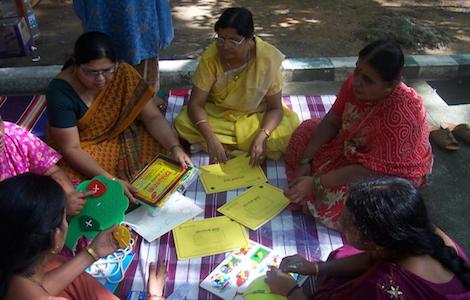
A set of readers
Conversation cards
Workbook
Flash cards – Kannada and English alphabet, numbers
Alphabet strips, Number strips
Counting Board
Slates/Chalk
Book of rhymes (for teacher)
Creative work
Drawing Book
Paint Box
Crayons
Pencils
Capacity building
For pre-school teachers and monitoring of activities.
Assessments
Assessments are an essential part of tracking the effectiveness of the initiative and this has to be done in a non-intrusive manner. Each assessment covers aspects of child development like motor skills; cognitive skills; social and emotional skills; language skills. Assessment formats have been designed. Progress of every child will be measured - reports will however, be aggregated and distributed. Performance benchmarks by centre; by area; by project and each compared to district averages will be tracked and made available. Children have been assessed on 7 sets of competencies using 56 indicators:
General Awareness
Gross Motor Development
Fine Motor Development
Language Development
Intellectual Development
Social and Emotional Development
Pre-academic Skills